Philosopher Chats
Engage in friendly and engaging chats over coffee with some of the world’s most influential educational philosophers.
About This Assignment
In this activity you will engage with a custom built chatbot that roleplays as a noted educational philosopher. These chatbots were created using ChatGPT’s Custom GPT feature. The goal of this activity is to engage in a simulated coffee chat designed to foster philosophical inquiry through dialogue to gain further insight and understanding of each philosopher’s ideas and writings. You will be challenged to reflect on your own beliefs and experiences and to think critically and more deeply about the subject matter.
Refer to the assignment instructions and rubrics posted in Moodle for further details.
Frequently Asked Questions
A GPT is a custom version of ChatGPT fine-tuned to perform specific tasks or behave in a certain way based on a set of instructions and training knowledge. In this case, we have created a set of GPTs to roleplay as historical philosophers.
Yes, a free ChatGPT account is required to access custom GPTs. You can login with an existing ChatGPT account or create a new one. If you do not have an existing account and do not wish to create one, please discuss alternative options with your instructor.
Before using AI tools, it’s important to know how your data is being used. Some tools collect and store everything you type and might use it to train future models. Reading the privacy policy helps you understand what’s being collected, who can see it, and how it might affect your privacy, academic work, and digital rights. Be sure to familiarize yourself with OpenAI’s Privacy Policy
Although you will likely be prompted to reflect on your personal experiences and philosophies, do not enter personal or sensitive information, as this information may be used to further train ChatGPT and could be exposed to other users. This includes any information that could be used to personally identify you, as well as copyrighted works.
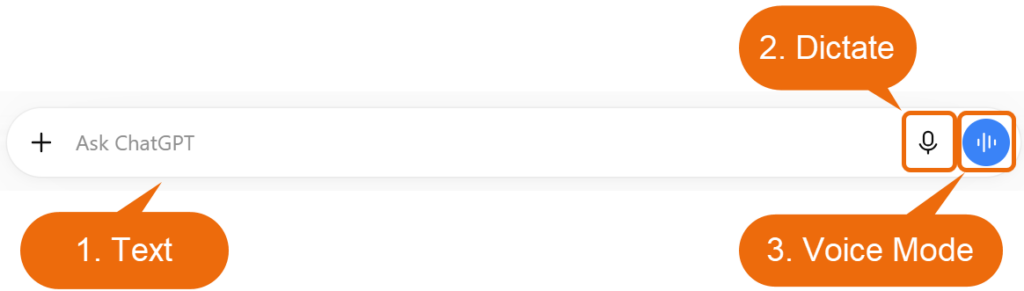
You can interact with each philosopher in the following ways:
- Text: complete your chat using ChatGPT’s text box and receive text responses.
- Dictation: Your speech turns into editable text on your screen, letting you draft and refine your prompt before submitting it.
- Voice Mode: A real-time, two-way verbal conversation where you talk out loud and ChatGPT talks back to you audibly. Your voice and the AI’s voice will be transcribed.
Note: the voice that you hear will be whichever voice you have selected in your account settings. With voice mode active, you can change the default voice by selecting the voice settings icon in the top-right corner. You can choose from a small number of preset options which may or may not match with your selected philosopher, so you may find that this negatively impacts the immersiveness of the experience.
While we have made every effort to ensure these chatbots engage in an authentic manner and draw on each philosopher’s ideas and writings, they may still produce misleading or fabricated content. As such, approach each interaction critically. These chatbots should not be viewed as a source of authority, but rather a way for you to further engage with the teachings of each philosopher. AI tools can also reflect the societal and cultural stereotypes inherent in their training data, and produce content that perpetuates existing stereotypes, inequalities and discriminatory perspectives. It is important that you critically engage with AI-generated content to verify it’s accuracy and check for potential biases. This checklist can help with process. Use the arrow buttons to navigate between each slide below.
Yes, ChatGPT does place a limit on your interactions. Unfortunately, ChatGPT isn’t totally transparent on how the usage rate is calculated. It can vary depending on your subscription tier (free or paid) and seemingly the time of day. This means that you may have to complete this activity in more than on sitting (so don’t leave it until the night before it’s due!). If you find that you reach the usage limit, try again in 3-5 hours and it should be reset.
Here are a few strategies to help you keep under the limit:
- avoid inputting or requesting the generation of images or audio
- enter more fleshed out and detailed prompts instead of frequent short prompts, as this requires ChatGPT to check its knowledge base each time
- save and export your interactions to make sure they are not lost and can be referred back to (see below)
You might find that you need to refer back to your conversation with one of the philosophers, share your chat history with your classmates or instructor, or continue a previous conversation. Conversations with ChatGPT are typically saved in the left-hand menu under “Chats.” To share your conversation history, you can:
- Click the “Share” button in the top-right corner. This will create a shareable link to your conversation that opens in ChatGPT. Further interactions are not included in the original link.
- Copy and paste your entire chat into a text document, such as Microsoft Word. The easiest way to do select your entire chat history is “Ctrl + a” on your keyboard.
You can also manage your chat history by:
- Archiving your chats by clicking “…” in the top-right corner and selecting “Archive.” Archived chats are removed from your chat history list. They can be accessed and restored in your profile settings under “Data Controls.”
- Requesting an export of your complete chat history by clicking Settings -> Data Controls -> Export data.
Confucius
551 – 479 BCE | China
Confucius was a Chinese philosopher who is traditionally considered the paragon of Chinese sages. His teachings became the foundation of Confucianism and helped shape Chinese culture, politics, and education.
Plato
Approx. 428 – 348 BCE | Athens
Plato was an ancient Greek philosopher of the Classical period who is considered a foundational thinker in Western philosophy. He was the founder of the Platonic Academy, a philosophical school in Athens where Plato taught the doctrines that would later become known as Platonism.
Kant
1724 – 1804 | Königsberg, Prussia
Immanuel Kant was a German philosopher born in Königsberg, Prussia, where he spent most of his life studying and teaching. One of the most influential thinkers of the Enlightenment, Kant made major contributions to ethics, metaphysics, epistemology, and aesthetics,
Dewey
1859 – 1952 | United States
John Dewey was a prominent American philosopher, psychologist, and educational reformer. His belief in democracy was a major overriding theme in his works. He emphasized experiential, student-centered learning and believed that education should prepare individuals for active participation in democratic life.
Tagore
1861 – 1941 | India
Rabindranath Tagore was an Indian poet, philosopher, educator, and Nobel Prize–winning writer whose works spanned poetry, music, art, and social thought. He founded Visva-Bharati University and promoted an education rooted in creativity, freedom, and harmony with nature, influencing both Indian and global perspectives on learning and culture.
Greene
1917 – 2014 | United States
Maxine Greene was an American educational philosopher, author, social activist and teacher. She is widely considered a pioneer for women in the field of philosophy of education. She championed the role of imagination, the arts, and aesthetic experience in fostering critical awareness and social change, and urged educators and students to “wide-awakeness,” engaging with the world reflectively and creatively.
Freire
1921 – 1997 | Brazil
Paulo Reglus Neves Freire was a Brazilian educator and philosopher best known for his influential work Pedagogy of the Oppressed, in which he reimagines teaching as a collaborative act of liberation rather than transmission. His approach to education challenged traditional “banking” models of teaching and inspired movements for social justice and transformative pedagogy worldwide.
Wiredu
1931 – 2022 | Ghana
Kwasi Wiredu was a Ghanaian philosopher renowned for his work in contemporary African philosophy, particularly in developing concepts of “conceptual decolonization” to free African thought from undue dependence on Western frameworks. He emphasized the importance of using African languages and cultural perspectives in philosophy, contributing to global discussions on democracy, personhood, and morality.